The Martyrs of Legal Terrorism
A state sponsored Genocide
by Rudolph Dsouza · 20261024004
★ 5 (1 rating)
This book aims to expose how, much like the misuse of anti-terror laws that led to prolonged detentions without trial, domestic laws have created a parallel system of persecution where accusations alone become tools of torture. Through extensive case studies and testimonials, I demonstrate how the very institutions meant to protect citizens have become instruments of harassment through a calculated nexus of corrupt stakeholders, like Police, Lawyers, Judges and women Organisations.
$10.00
Sample
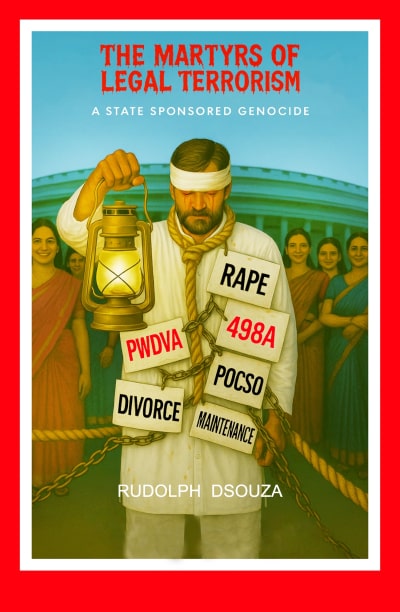
Man: Blindfolded, chained, noose around his neck, placards naming anti-men laws hanging from him, lantern in his hand during daytime.
Women: Laughing in the background.
Setting: In front of the Parliament of India (the symbol of law-making and democracy).
This image appears to be a powerful symbolic representation. Here’s a possible interpretation of each element:
1. Blindfolded man: Could represent a lack of clarity, justice, or fairness for men, or being kept in the dark about issues affecting them.
2. Chained: May symbolize feeling restricted, oppressed, or limited by societal expectations or laws.
3. Anti-men laws placards: Clearly indicate criticism or opposition to laws perceived as discriminatory against men.
4. Rope with a noose: This is a very stark and potentially provocative symbol. It could represent feelings of desperation, hopelessness, or even suicidal thoughts among men due to societal pressures or legal injustices.
5. Lantern in broad daylight: The lantern might symbolize a search for truth, justice, or understanding that’s not being met, even in plain sight (broad daylight).
6. Women laughing in the background: Could represent:
– Mockery or dismissal of men’s issues.
– Perceived lack of empathy or understanding.
– Power imbalance or perceived privilege.
The overall image seems to convey a strong message about perceived injustices against men and the emotional toll it takes. However, the use of the noose is particularly striking and could be seen as referencing serious mental health concerns or even self-harm, so it’s essential to approach this symbol with sensitivity.
Meaning of each Symbol:
Symbol Meaning
Blindfold The man is blind — not by choice, but by force. It symbolizes lack of awareness, denial of justice, or being rendered helpless by the system. He is not even allowed to “see” the injustice done to him.
Chains He is enslaved or trapped — showing that anti-men laws have stripped away his freedom. He cannot fight back or escape.
Noose (tightened rope around neck) Represents legal death or social death — the pressure of false cases and biased laws is literally killing him, mentally, emotionally, and sometimes physically (suicides).
Placards with names of anti-men laws Each placard represents a specific law misused against men, such as IPC 498A, DV Act, POCSO misuse, Rape law misuse, Maintenance laws, etc. These laws, though designed for protection, have become instruments of harassment in many cases.
Lantern in broad daylight Lantern is a symbol of searching for truth or justice. Having a lantern in broad daylight suggests a mockery — that even when everything is visible (daylight), the man still needs to “search” for justice because it’s hidden or denied to him. A deeper reference could be Diogenes’ lantern — Diogenes, a Greek philosopher, roamed in daylight with a lantern “searching for an honest man.” Here it suggests searching for justice or fairness, which has become impossible.
Women laughing Symbolizes mockery of men’s pain. It points to how society sometimes trivializes or even celebrates men’s suffering under the label of “gender justice” without realizing the human cost.
Parliament building in background This setting says — the very system that makes the laws is watching silently, allowing or even encouraging this injustice to happen. It is a direct accusation against lawmakers and policy makers.
The image conveys a strong message about perceived injustices and frustration. The women’s laughter adds a sense of disillusionment and anger. The entire scene is a bold, visual accusation that men are being blinded, chained, strangled, and mocked by biased laws, while the lawmakers (Parliament) do nothing to stop it.
It shouts that “justice for men is dead” and they are left searching for fairness where it no longer exists.
All in one Para.
In broad daylight, under the nose of the very Parliament that boasts of justice and equality, a man is paraded like a criminal. Blindfolded so he cannot see his oppressors, chained so he cannot resist, strangled by a noose woven out of biased, blood-stained laws. Each placard hanging from him screams the names of legal weapons crafted in the name of protection, now used to destroy innocent lives. A lantern burns in his hand — a tragic, bitter joke — because even under the full light of truth, justice remains invisible to him. In the background, the laughter of women mocks his suffering, society’s approval etched in every smile. The lawmakers who created this circus watch silently from their thrones, drunk on vote-bank politics and fake narratives.
A cruel chorus of those who mock his suffering, oblivious to the weight of injustice that crushes him. And towering above it all, the Parliament stands silent, a grand monument to the death of truth. In this land of ancient wisdom, the new gods are blind vengeance and false virtue — and the common man has become their forgotten sacrifice.
This is not just injustice — this is legal terrorism against men. And we refuse to be silent slaves any longer.
If democracy has abandoned us, we will shake its very foundations.
Ratings
Log in to rate this book. You must have reading access.